



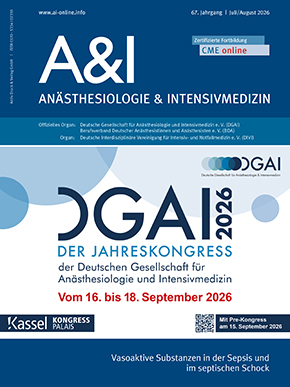
Aktuelle Ausgabe - 67. Jahrgang - Juli / August 2026
Übersichten | Review Articles
Zertifizierte Fortbildung | Continuing Medical Education (CME)
J. Welzer · E.-M. Kroiß · S. Zumsande · D. Raum · H. Leger · C. Raspé
Vasoaktive Substanzen in der Sepsis und im septischen Schock
Schlüsselwörter
Sepsis – Septischer Schock – Vasoplegie – Vasopressoren – Inotropika – Personalisierte Therapiestrategie
Keywords
Sepsis – Septic Shock – Vasoplegia – Vasopressors – Inotropics – Personalized Therapy Strategy
Zusammenfassung
Sepsis und insbesondere der septische Schock mit Multiorganversagen stellen hochkomplexe Krankheitsbilder mit hoher Letalität und erheblichen sozioökonomischen Folgen dar. Zentrales pathophysiologisches Merkmal ist die Vasoplegie mit konsekutivem distributivem Schock. Entscheidend ist das rasche Erkennen dieses vitalen Notfalls und eine adäquate hämodynamische Stabilisierung.
Grundlage hierfür ist ein profundes Verständnis der Pathophysiologie und der Pharmakotherapie. Noradrenalin ist gemäß nationalen und internationalen Leitlinien der Vasopressor der ersten Wahl. Reichen Volumentherapie und Noradrenalin nicht aus, um eine ausreichende Organperfusion bei einem angestrebten mittleren arteriellen Druck (MAP) in Höhe von 65 mmHg sicherzustellen, wird die additive Gabe von Vasopressin empfohlen. Bei septischer Kardiomyopathie wird Dobutamin vorgeschlagen, wohingegen Adrenalin aufgrund ungünstiger Nebenwirkungen nicht mehr empfohlen ist. Glukokortikoide können adjuvant zur Verbesserung des Gefäßtonus und zur Immunmodulation eingesetzt werden. Der Einsatz von Betablockern wird weiterhin kontrovers diskutiert und kann laut S3-Leitlinie bei Patientinnen und Patienten mit supraventrikulären Tachykardien individuell erwogen werden, sollte jedoch nicht routinemäßig erfolgen. Zunehmend rücken personalisierte Strategien in den Fokus, die Auswahl und Dosierung von Volumen, Vasopressoren und Inotropika an hämodynamischen Zielgrößen, Bio-markern und der individuellen Kreis-laufphysiologie orientieren.
Summary
Sepsis, and in particular septic shock with multiple organ failure, represent highly complex disease patterns with high lethality and significant socioeconomic consequences. A central pathophysiological feature is vasoplegia with consequent distributive shock.
Crucial is the rapid recognition of this life-threatening emergency and adequate hemodynamic stabilization. The basis for this is a profound understanding of pathophysiology and pharmacotherapy. According to national and international guidelines, norepinephrine is the first-line vasopressor. If fluid therapy and norepinephrine are not sufficient to ensure organ perfusion at a target mean arterial pressure (MAP) of 65 mmHg, an additional administration of vasopressin is recommended. In case of septic cardiomyopathy, dobutamine is sugges-ted, whereas adrenaline is no longer recommended due to its unfavorable side effects. Glucocorticoids can be used as an adjunct to improve vascular tone and for immunomodulation. The use of β-blockers is still controversially discussed and, according to the S3 gui-deline, can be considered individually for patients with supraventricular tachycardias and should not be used routinely. Increasingly, personalized strategies are coming into focus, where the selection and dosing of fluids, vasopressors, and inotropes are oriented towards hemodynamic target parameters, biomarkers, and individual circulatory physiology.
zur Gesamtausgabe 04/2026 pdf

Supplements
Supplements OrphanAnesthesia